Auld Lang Syne
Faiza Hameed and Ali Madeeh Hashmi  TFT Issue: 05 Dec 2014
In the annals of Urdu Literature Iqbal, Faiz and Patras are rarely thought of together. Faiza Hameed and Ali Madeeh Hashmi draw a thread connecting the three giants whose works and lives addressed life’s big questions
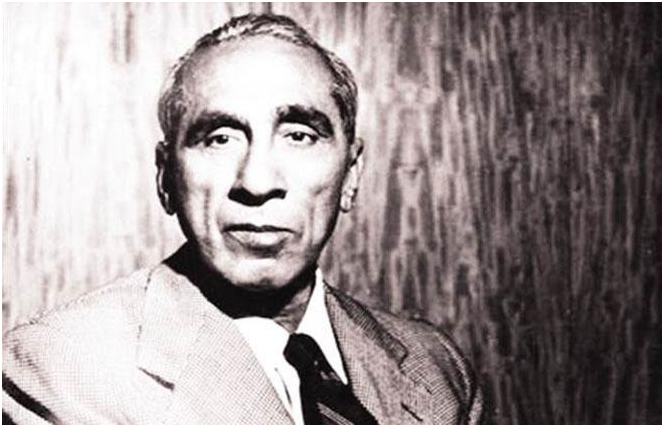
Patras Bokhari
In November 1945, at the end of the Second World War, the great Russian poet, Anna Akhmatova met Isaiah Berlin (“the dominant scholar of his generation”), then First Secretary at the British Embassy in Moscow. It was a meeting that lasted through the better part of the night, with the two talking about subjects as varied as the horrors of war, the pervasive tyranny of Stalinist Russia and Akhmatova’s tragic personal losses. Isaiah Berlin subsequently returned to Britain and Akhmatova was later denounced by the Central Committee of the Communist Party for cavorting with a “foreign spy” and expelled from the Writer’s Union. But the meeting marked the beginning of a long, close friendship, a syncing of two brilliant and beautiful minds that defied convention and spanned continents.
Akhmatova later composed her poem “Cinque” as a fond remembrance of her meeting with Berlin.
“Sounds die away in the ether
And darkness overtakes the dusk
In a world mute for all time
There are only two voices: yours and mine.”
(Anna Akhmatova: Biography, The Poetry Foundation)
“Allama” Muhammad Iqbal, Ahmad Shah Bokhari “Patras” and Faiz Ahmad “Faiz” lived in succession through one of the richest cultural periods in the history of the subcontinent. Their lives diverge at many places and in many directions, intersecting in the green and gold promenades of Lahore and its ancient Government College. In their own separate ways the trio helped shape the academic and sociopolitical climate of their times, their influence transcending generations.
“No man was ever yet a great poet,” wrote Coleridge, “without being at the same time a great philosopher.” Early in his life, Iqbal’s academic pursuits took him to Europe where he was introduced to the likes of Bergson, Goethe and Nietzsche. He eventually adopted Rumi as his spiritual mentor, giving the great Sufi center-stage in his epics, Asrar-e-Khudi and Bal-e-Jibreel. Despite his deep understanding of philosophy, his poetry was always meant for the common man. Some of his earlier works may well have relied heavily on flowery rhetoric and abstract themes, but he remained till the end, a poet of the masses, his pen a means through which “all the inner intellectual contradictions, all the conflicting impulses, all the confused dreams and aspirations of the middle strata of Indo-Pakistani Muslims” were able to find a wider audience. (“Iqbal, the poet” by Faiz Ahmed Faiz)
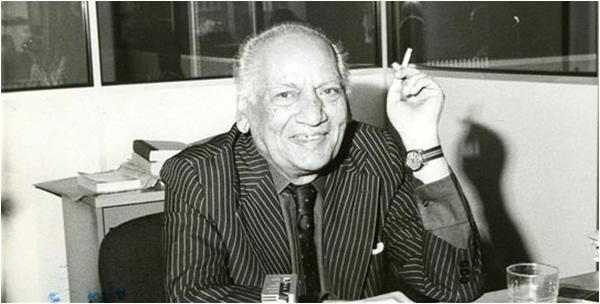
Faiz Ahmed Faiz
The evolution of Iqbal’s poetry, from his pre-occupation, as a young poet, with the sun, the stars and the lover’s pain to his recognition of the problems of his fellow Indians post-World War I and later the dawning awareness of the need for a “pan-Islamic” brotherhood and man’s place in the grand scheme of the universe, is a fascinating study.
“You have a burden,” Josef Breuer once said to his young student, Sigmund Freud, “The richer the soil, the more unforgivable the failure to cultivate it.” Like a true seer, Iqbal too sought to transfer his vision to those worthy of it.
Mehroom e Tamasha Ko Phir Deeda e Beena De
Dekha Hai Jo Kuch MeiN Ne AuroN Ko Bhi Dikhla De
(Give the power of vision to those deprived of sight, O Lord!
Give them the power to see what I have seen)
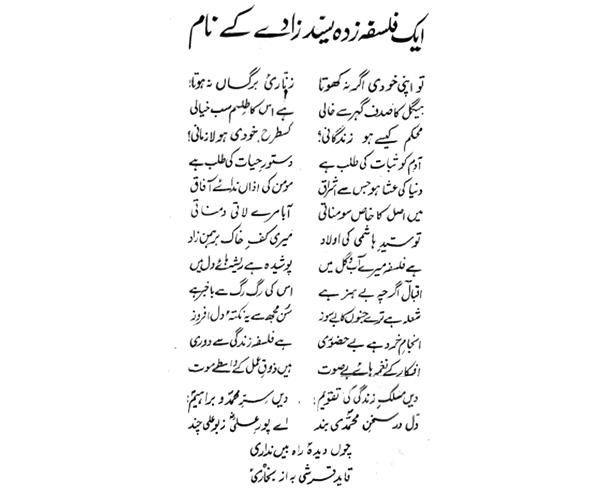
The young Patras was the subject of Iqbal’s poem, “Aik Falsafa-Zadaa Sayyed Zaaday Kay Naam”
Allama Iqbal passed away in April 1938, nine years before his vision of a separate Muslim homeland came into being. He is venerated as the national poet of Pakistan, a country whose reality is tragically at odds with its poet’s vision. However the discrepancy is not for a lack of genius. Many brilliant stalwarts took up Iqbal’s mission from where he left off. Ahmad Shah Bokhari, more fondly remembered as ASB, was serving as Professor of English Literature at Government College, Lahore when Iqbal died. His seminal collection of essays “Patras Kay Mazaameen” had been published in 1927 to great acclaim. Carving a niche of his own in Indian literary circles, Patras held Iqbal in high esteem, and got him to write a letter of recommendation for him before leaving for his Tripos from Cambridge University in 1925. The young Patras was the subject of Iqbal’s poem, “Aik Falsafa-Zadaa Sayyed Zaaday Kay Naam” (To a philosophical Son of a Sayyed) after he checkmated the renowned poet-philosopher in a literary duel over the philosophy of Bergson.
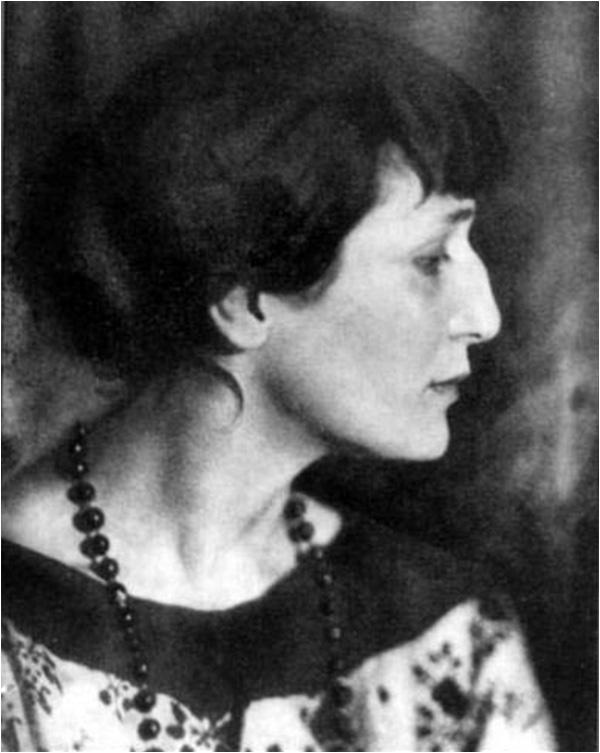
Anna Akhmatova
Highly ambitious, with talent to match, ASB served as Professor and later Principal of Lahore’s prestigious Government College, the first “native” to become the Director General of All-India Radio, Liaquat Ali Khan’s personal speech-writer, and later Pakistan’s permanent representative at the United Nations. His work ethic was legendary. “His brain ran faster than his body which ran faster than his brain.” His dear friend and colleague, Sufi Tabassum recalls in his essay, Patras Bukhari Marhoom (The Late Patras Bokhari). “One evening his friends convened a literary meeting at his house. Patras [who was serving as Secretary of the Punjab Textbook Committee at the time] emerged from a side-room, his sleeves rolled up, his hands caked with dust. “I won’t be able to join you fellows!” he said. “I am extremely busy tonight.” The next morning we found out that he had spent the whole night preparing a report on the Textbook Committee’s twenty-five years of functioning…Had it been done through the usual bureaucratic process the report would have taken months, and yet [Patras] did it single-handedly in one night.”
His personal discipline proved invaluable to him later when he joined the U.N. He was, in the words of his student Hanif Ramay, a “Renaissance Man” brimming with passion and committed to making his time at the UN worth his while. His efforts in saving the UNICEF from dissolution, his whole hearted support for the African colonies and the Tunisian independence movement and his role in introducing the international community to Asia and its problems are all well known. He was very clear-sighted about the responsibility of the nations of the First World, especially America, asking them to come forward and play their part in the social and economic emancipation of nations steeped in poverty and disease.
“There’s a pattern in the stories. Always a little man, with little inadequacies, drawn by human foibles into a situation in which he doesn’t belong… Pakistanis love that”
His activities as a litterateur, translator, actor and producer of theatre provided a wonderfully light-hearted side to his highbrow diplomatic duties. Speaking to an interviewer once about his essays, he said, “There’s a pattern in the stories. Always a little man, with little inadequacies, drawn by human foibles into a situation in which he doesn’t belong… Pakistanis love that. My motto is ‘Be gentle.’”
It was precisely his gentle flirtation with life’s inadequacies that won him a wide circle of admirers and friends: his student and later close friend, Faiz Ahmad Faiz, his associates, Sufi Tabassum, M.D.Taseer, Imtiaz Ali Taj, poetess par excellence and the first woman president of the Indian National Congress, Sarojini Naidu, his childhood friend, Somnath Chib, Chiragh Hasan Hasrat, Agha Hameed and many others. While at the UN, he once joked about the inexorable divide between East and West in an interview. “I used to send long letters about America to my students at Lahore, to be read to them in groups. In one of them, I mentioned that there is a drugstore on every corner. They wrote back in alarm, and in my next letter I had to explain that drugstores are not for dispensing illegal narcotics. Someday, when I am wise enough, maybe Patras will write about America.”
ASB left behind a slim book of essays and a sparkling legacy. Faiz Ahmad Faiz wrote a beautiful essay in his remembrance after he died. One of Bokhari’s favorite students at Government College, Faiz was only too aware that beneath the veneer of frivolity, ASB was brimming with the passion of living a purposeful life. It was this sense of doing justice to his potential that Faiz inherited from his mentor and friend.
Ludmila Vassilyeva, Faiz’s travel-companion and translator mentions how in her eyes, Ghalib, Hali, Iqbal and Faiz are a continuation of the same literary chain. In his own quiet way, Faiz became the next torchbearer of humanist values. Witness to the blood-smeared mayhem of the Partition of 1947, a saddened Faiz wrote to his wife who was in Srinagar at the time with their two girls. “The Muslims have got their Pakistan, the Hindus and Sikhs their divided Punjab and Bengal,” he wrote, “but I have yet to meet a person, Muslim, Hindu or Sikh who feels enthusiastic about the future. I can’t think of any country whose people felt so miserable on the eve of their freedom and liberation.”
He was working as the editor of the left-wing English newspaper, Pakistan Times and many a bold editorial was born from his pen as he took on the defunct state machinery. “There are no halfway houses between liberty and thralldom.” He wrote in one of his editorials about the infamous Public Safety Ordinance passed in October 1948. “The public have to choose and decide whether they are going to permit this and similar inroads on their hard-won freedom or whether they are content to live in daily fear for their freedom and honor.”
Surrounded as he was by people who often confused dissent with disloyalty, Faiz nevertheless had a tight clique, led by his life-long companion and love, Alys, that stood by him and urged him on. “Shaa’er e Mast” (Intoxicated poet) was Patras’s endearing nickname for him. Patras would often drop by their apartment which in Alys’s words, “was just opposite what was then Radio Pakistan, fifty yards or so from Government House and bang next door to the American Consulate. Imagine what good company we were in”. They would saunter off after dinner, taking along “Chiragh Hasan Hasrat and perhaps Majeed Malik… to drive nostalgically to the Canal or gardens to talk of poetry and old times.” It was this influence of like-minded friends that soothed Faiz’s heart in his darkest days.
Writing about the encounter between Isaiah Berlin and Anna Akhmatova, the NY Times wrote “(They) were from a culture that assumed that if you want to live a decent life, you have to possess a certain intellectual scope. You have to grapple with big ideas and big books…written by geniuses who understand us better than we understand ourselves.”
They would huddle together along deserted roadsides in the wee hours of the morning
Iqbal, Patras and Faiz were the most brilliant minds of our recent history. They shared the common language of literature and did wonderful things for the world they inhabited. They were not idle pen pushers who sold their art to the highest bidder. Instead they used their pens to inspire, to teach and to illuminate. As another year draws to a close, and our collective national psyche continues to struggle to maintain its balance, it is worthwhile to remember a not too distant past in the history of Pakistan where the only battles worth fighting were those of wit; where a pensive poet, a frivolous Govt. College Principal and a host of young litterateurs would set out every night to “paint the town red”, and “huddle together along deserted roadsides in the wee hours of the morning, discussing Bedil’s complex verses, Shakespeare’s plays, Eliot’s portrayal of isolation as the primary theme of his work and Manto’s novels.” (Patras Bukhari Marhoom by Sufi Tabassum). It would be worthwhile to raise a toast to these stouthearted souls of yore whose lives burned brighter than the full moon and continue to illuminate a new generation of readers.
The death anniversaries of Iqbal, Faiz and Patras were on November 9, November 20 and December 5.
Dr. Faiza Hameed is a graduate of King Edward Medical University.
Ali Madeeh Hashmi is a Psychiatrist and a Trustee of the Faiz Foundation Trust. He can be reached at ahashmi39@gmail.com [1] or via his twitter @Ali_Madeeh
Copyright © 2019 www.patrasbokhari.com All rights reserved.
Produced by Syed Ayaz Bokhari.
Developed by Pakistan Data Management Services.
Source URL: https://new.patrasbokhari.com/content/auld-lang-syne
Links:
[1] mailto:ahashmi39@gmail.com