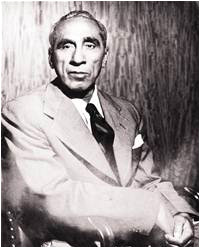
ASB came to Lahore’s Government College in 1916, obtained a BA degree, then changed his focus from Physics (his parents’ choice) to English literature. After doing an MA in English, he proceeded to Cambridge for his Tripos and soon distinguished himself there as well. For a while, he developed close friendships with renowned teachers in Cambridge such as Bennet, Lucas and Arthus Quiller-Couch. He returned after finishing his education and was eventually appointed Professor of English at Government College.
He was notorious for being merciless on students who did not display originality of thought. One former student, author Kanhaiya Lal Kapoor, writes in an essay: “In my first exam, I wrote several quotes from famous critics and writers. Mr. Bokhari gave me a zero and wrote ‘you have written verbatim quotes in several places from FL Lucas and Professor Quiller-Couch. They were my teachers in Cambridge and obviously I am not qualified to be their examiner. I am examining you.'”
Bokhari along with Sufi Ghulam Mustafa ‘Tabassum’, Dr. MD Taseer, Abdul Majeed Salik and many others represented a flowering of the Muslim intelligentsia of the two decades immediately prior to Partition. Educated in India as well as the best universities in England, they were immune to the imperious attitudes of the ruling British, deeply sensitive to the social and educational problems of the people of India and fired with a reformist spirit which burned brighter as independence approached. They were teachers and writers who inspired a whole generation of Pakistanis in the aftermath of Partition.
Faiz Ahmed ‘Faiz’, no mean judge of literary and poetic talent himself, held all of them in the highest regard and Bokhari was no exception. The two had a close personal friendship in addition to a student-mentor one. While Faiz always spoke reverently of his teacher, Bokhari, in typically irreverent style, once wrote to Faiz’s wife Alys from London a few months before his death in 1958: “I would love to hear news of your household but also know that he [Faiz] never will write since he is an intoxicated poet [“shair-e-must”]. I heard somewhere that he is being sent to jail then heard that the offer of hospitality had been withdrawn. I cannot decide what I find funnier, that they are going to lock him up or that they are not. You and I would prefer, of course, that he remain with us rather than us going around filling forms to see him.”
Patras was, seemingly, the epitome of the ‘brown sahib’ but without the usual negative connotations of the term. He appeared to have imbibed the best of both Eastern and Western cultures and arrived at a heady synthesis which was leavened by a sharp, cheerful sense of humor. His towering intellect is evident from two anecdotes which are now part of the Patras legend.
Mr. Muhammed Tufail, publisher of Naqoosh, recounts how on one occasion the young ASB, recently returned from Cambridge, engaged Allama Iqbal in a debate on the philosophy of Bergson, with both Allama Iqbal and Patras putting forth their respective arguments and logic. Finally, Iqbal relented. Iqbal’s poem ‘To a philosophical son of a Syed’ (‘ Ek falsafa zada Syed-zaaday ke naam‘) was written after this incident.
A little-known contribution of Bokhari is the survival of UNICEF, which was about to be disbanded after having completed its humanitarian mandate in devastated post-World War II Europe. Eleanor Roosevelt, wife of the US President, was the Chief US delegate. Bokhari as the chief delegate of Pakistan was elected to chair the Committee meeting. She read from the prepared US statement given to her, thanking UNICEF for a job well done and proposed its winding up. Bokhari at that point in a dramatic manner stepped down from the President’s Podium and resumed his seat as Pakistani delegate. He said that listening to Mrs. Roosevelt had felt like presiding over a funeral. UNICEF’s work in Europe may have ended but there were millions of suffering women and children in developing countries who needed UNICEF’s help. The reprimand stunned Mrs. Roosevelt. At the next day’s meeting of the Committee, she thanked Bokhari and reversed the US position. The UNICEF mandate was extended and it has remained the flag-bearer of humanitarian development.
ASB began his career at Government College, Lahore, his alma mater (whose enormous Bokhari Auditorium is named after him), moved to eventually become Director General of All India Radio in Delhi, then Principal of Government College and finally Pakistan’s first Permanent Representative to the UN in New York where he died in 1958. It would require several books to recount his achievements in full. The celebrated American poet Robert Frost wrote of him:
“From Iron
Tools and Weapons
To Ahmed S. Bokhari
Nature within her inmost self divides
To trouble men with having to take sides.”
Ahmed Shah Bokhari ‘Patras’ died on December 5, 1958 and is buried in Valhalla Cemetery in New York. As a mark of his respect for, and friendship with Frost, the above verses are inscribed on his tombstone.
Excerpt from ‘Lahore ka jughrafia’ (‘The Geography of Lahore’)
Location:
It is said that at one time Lahore used to have latitudes and longitudes but the municipality has decided to cancel those for the convenience of students. Now Lahore is surrounded on all sides by Lahore, Lahore and more Lahore and it is expanding day by day…Experts estimate that in ten or twenty years, Lahore will be a province whose capital will be Punjab. Imagine Lahore as a body with inflammation sprouting on every part…such that it is a vast disease inflicting this body.
Environment:
There are many kinds of traditions about Lahore’s environment, almost all of them wrong. The truth is that the denizens of Lahore have recently expressed a desire, like most city dwellers, that they be provided an environment and fresh air…Unfortunately, the committee has an acute shortage of air so people have been instructed that, for the common good, air should not be wasted and should be used sparingly wherever available. Thus, in place of air, dust and in certain instances, smoke, is used. The committee has, in numerous places, provided outlets for the provision of dust and smoke to the citizens of Lahore where these resources are distributed free of charge. It is hoped that this will provide satisfactory results.
Ali Hashmi is a trustee of the Faiz Foundation Trust and Faiz Ghar, Lahore (www.faizghar.net). He can be reached at ahashmi39@gmail.com